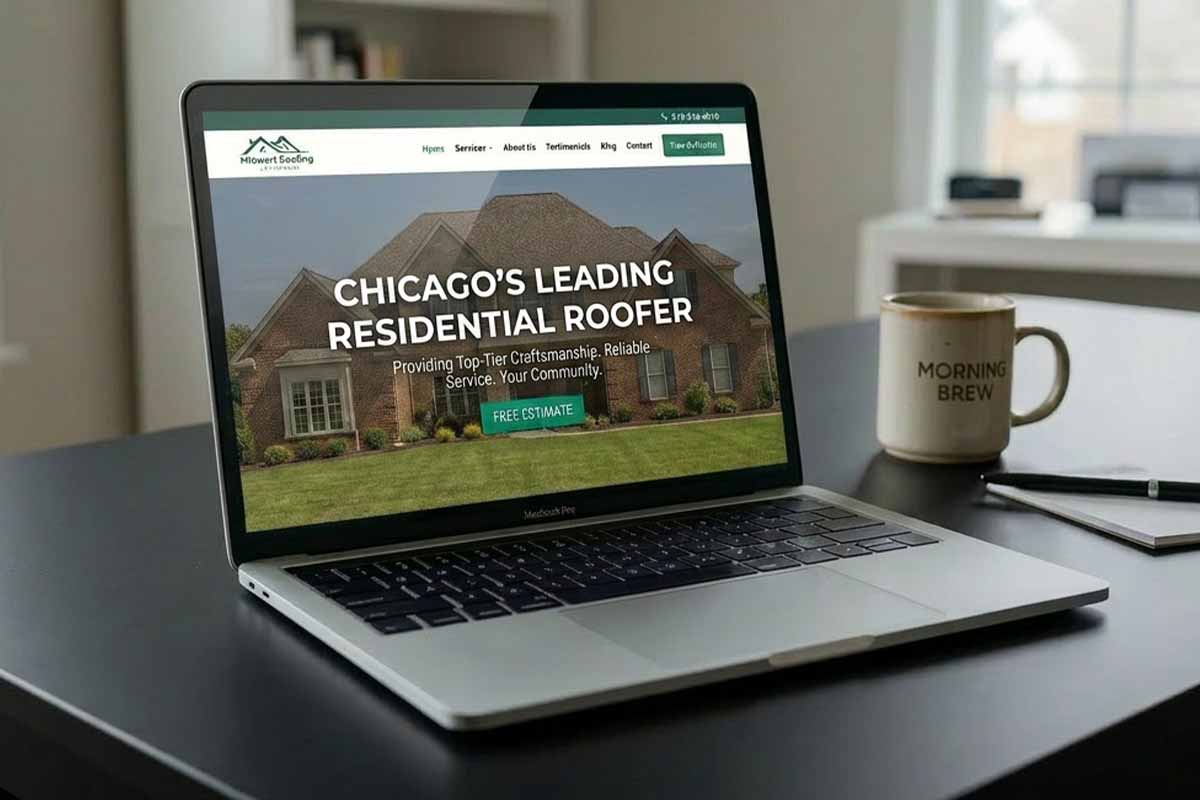
Your roofing company’s website could be your top salesperson. It works 24 hours a day, seven days a week, and never takes a vacation.
The problem is that most roofing companies have generic look-alike pages. They lack the optimization needed to climb to the top of search results, show up in Google’s AI answers, and get cited when homeowners ask AI tools questions. The best ones pull in visitors and prove you know your trade inside and out.
Designing a roofing website is only the starting point, and the twelve recommendations below cover what to focus on to build a site that works as hard as you do.
Building A Roofing Website That Wins More Jobs
Each tip below covers one specific area where roofing websites either win or lose the lead. Some tips are technical, others are about content, and some are about giving homeowners the confidence to pick up the phone. Each play an important role in the user experience.
1. Build Mobile First
More than 60% of searches start on a phone. As homeowners spot a missing shingle, inspect for storm damage, or sit on the couch to compare contractors, the phone is always close by to research solutions and roofing companies. If your site doesn’t load cleanly on a screen that size, you’ve already lost them.
A mobile-first build prioritizes the small-screen experience from the start. For instance, phone numbers should be click-to-call, forms should be short and straightforward, and navigation should work with one hand.
Since July 2024, Google has used mobile-first indexing for every website it crawls, so the mobile version of your site is what gets ranked. A desktop site that looks great but cramps up on a phone won’t get the search visibility you’re paying
2. Hit The Three-Second Load Mark
53% of mobile visitors abandon a page that takes longer than three seconds to load. Let’s face it- we’ve all become impatient in a digital age that has rewired our expectations for instant gratification.
Speed is a ranking factor and a conversion factor at the same time. Google’s Core Web Vitals measure how fast your page loads, how quickly it becomes interactive, and how stable the layout is while loading. Sites that score poorly end up dropping in search results.
The usual culprits behind a slow roofing site are uncompressed images, bloated themes, too many plugins, and cheap hosting. Project photos in particular tend to drag pages down because contractors upload them straight from a phone without resizing. Fixing those issues is rarely
complicated, but it’s the difference between a homeowner reading about your warranty and one bouncing to the next result.
3. Build Dedicated Service Pages
Every roofing service you offer deserves its own page. Roof replacement, storm damage repair, gutter installation, commercial roofing, inspections, emergency repairs, and so on. Each one has different keywords, different intent, and different homeowner questions attached to it.
A single “services” page that lists everything you do won’t rank for any of it. Google rewards depth and topical authority, so pages built around one specific service outperform pages trying to cover five. AI tools follow the same logic. When ChatGPT or Gemini pulls a source on “how much does storm damage repair cost,” they cite the page that answers that question directly, not the catch-all page that mentions it in passing.
Each service page should be dedicated to a specific service, who it’s for, what’s involved in the process, and what it typically costs. Add real photos from past jobs and answers to the questions you hear on every estimate call and this will build trust and save you time.
4. Create City and Service-Area Pages
46% of all Google searches have local intent, and roofing is as local as it gets. A homeowner in one suburb doesn’t want a contractor from across the state. They want someone who knows their neighborhood, their housing stock, and the storms that hit it.
Service-area pages give you a place to rank for those searches. One page for each city, town, or neighborhood you cover, each one targeting the “[service] in [city]” queries that homeowner’s type. This is the cornerstone of a strong local SEO strategy for roofers.
These pages can’t be copy-paste jobs with the city name swapped out. Google penalizes that, and homeowners see right through it. Each page should include local context. The more specific, the better the page performs in both search results and AI citations.
5. SEO-Optimized Content
Showing up in search results is the most reliable way to get in front of homeowners who don’t already know your name. That visibility comes down to two things: using high-ranking keywords and publishing fresh content on a regular schedule.
Keyword research is the foundation. The terms that bring in valuable leads are specific to your services and your service area, like “asphalt shingle replacement in Naperville” or “storm damage repair near me.” A focused roofing SEO strategy maps those keywords to the right pages on your site so each one ranks for what it’s meant to rank for.
Blogging provides an opportunity to publish new content on a regular basis. Search engines reward sites that publish consistently because fresh content signals that the site is active and worth showing to more people. Each article can focus on a particular search term or long-tail key phrase that will help increase visibility in search engines and AI overviews.
For more on getting found in your service area, read our guide on improving local SEO for your roofing company.
6. Structure Content For AI Answers
Although SEO should be at the top of your optimizations list, homeowners are starting to ask ChatGPT, Perplexity, and Google’s AI Overviews for help as well. Instead of showing links, AI agents give one synthesized answer and cite the sources behind it. If you want to be one of those sources, your content has to be built for extraction.
The format that gets cited follows a simple pattern. Use question-based H2s (“How long does a roof replacement take?”), then answer the question in the first one or two sentences before expanding with detail. AI engines pull from the opening lines of each section, so a vague intro buries the answer where the model never sees it. This approach works for service pages, blog posts, and FAQ sections.
7. Show Real Work, Not Stock Photos
Homeowners can spot a stock photo from across the room. The guy in the orange polo holding a clipboard, the perfectly clean shingles, the staged smile. They’ve seen it on every other roofing site in town, and it tells them nothing about your work.
Real photos do the opposite. A gallery of roofs you’ve finished, crews you employ, and homes that look like the ones in their neighborhood builds trust quickly. Project pages with before-and-after shots, drone photos of completed jobs, and the occasional in-progress action shot give homeowners proof that you do what you say you do.
A professional photo shoot gives you a library of images you can use across your website, social media, ads, and printed materials. And every new job is a chance to add to that library. A few good photos from each project keep your site looking current and your portfolio growing without much effort.
8. Make Trust Signals Impossible To Miss
Homeowners shopping for a roof are nervous. They’ve heard the horror stories about fly-by-night contractors, storm chasers, and jobs that fall apart two winters in. Trust signals are how you tell them, before they even pick up the phone, that you’re none of those things.
The strongest signals come in a few forms. License and insurance info should be visible, not buried on an “About” page. Manufacturer certifications like GAF Master Elite or Owens Corning Platinum Preferred are valuable because homeowners put their trust in these brands. In addition, a Better Business Bureau accreditation, Angi award, and industry association memberships (National Roofing Contractors Association, state and local builders’ groups) add another layer of trust and credibility.
That said, the social proof from authentic reviews can do more good than any badge. A live Google reviews widget showing your rating and recent feedback is gold. Place these signals near every call-to-action, not just in the footer. A homeowner about to click “schedule an inspection” should see your rating, your certifications, and your years in business right next to the button.
9. Put Video Testimonials Front and Center
Written testimonials are easy to fake, and homeowners know it. A 30-second video of a real customer talking about their roof, their experience, and why they’d hire you again is a different category of proof entirely.
Video on a landing page can lift conversions by up to 80%. This is because video testimonials are trusted more than any other form of social proof. They also keep visitors on your site longer, which signals to Google that your content is worth showing to more people. Hosting the same videos on YouTube extends the reach further, since YouTube is the second-largest search engine in the world.
Don’t be afraid to ask customers to record a short video and add to the website. Give them three or four questions to answer and let them speak naturally. A handful of these on your homepage and service pages will outperform a wall of written reviews every time.
10. Offer Multiple Ways To Convert
Not every homeowner is ready to call. Some are still researching, some are price-shopping, some are checking you out at 11 p.m. while their spouse is asleep. If a phone number is the only way to reach you, you’re losing the leads who aren’t ready to talk yet.
A live chat widget catches the visitor with a quick question about warranty or service area. An instant estimate calculator gives a ballpark number to the homeowner who isn’t ready for a sales conversation but wants to know if you’re in their range. Online appointment booking lets serious buyers lock in an inspection slot without picking up the phone, which is especially valuable for the after-hours traffic that makes up a big chunk of roofing searches.
Each of these tools captures a different kind of intent. The visitor who books an appointment is further along than the one who runs the calculator, who’s further along than the one who opens the chat. Offering all three lets you meet homeowners where they are instead of forcing every visitor through the same narrow door.
11. Give Visitors A Reason To Stay In Your Funnel
Most visitors to your site aren’t ready to buy today. Some are storm victims still figuring out their insurance. Some are budgeting for a replacement six months out. Some are weighing repair against replacement and don’t know enough yet to decide. If you don’t give them a reason to stick around, they’re gone, and you have no way to find them again.
Lead magnets solve that problem. A downloadable guide to filing a roof insurance claim, a homeowner’s checklist for spotting storm damage, a breakdown of what to expect during a roof replacement. Each one trades value for an email address, which puts the homeowner in your funnel even when they’re months away from hiring anyone.
Once they’re on your list, you have a way to stay in front of them. A short monthly newsletter with seasonal tips, recent projects, and the occasional offer keeps your company top of mind without being pushy. When the time comes to pick a contractor, the roofer who’s been showing up in their inbox has an advantage over the dozen names they’d have to start researching from scratch.
12. Let Homeowners Design There Own Roof
Two of the biggest shingle manufacturers offer free design tools that let homeowners take an active role in picking out their new roof, which is a powerful thing to provide during the research phase. A homeowner who spends ten minutes designing their roof on your site is a homeowner who’s already invested in the outcome.
Owens Corning’s Design EyeQ lets homeowners upload a photo of their home or pick from existing images that match their roofline and color scheme, then preview different shingle lines and colors on it. They can save, print, and share their designs. This tool is available to Preferred and Platinum Preferred Contractors.
GAF’s Design Your Roof tool covers similar ground with a drag-and-drop interface that suggests styles based on the homeowner’s preferences. It also routes quote requests directly to certified contractors in the area, which can deliver pre-qualified leads to your inbox without you lifting a finger.
Ready To Build A Website That Converts Clicks To Customers?
Designing a roofing website that converts takes more than a template and a contact form. If your current site is underperforming or you’re starting from scratch and want it done right the first time, book a call and we’ll walk through where things stand.
While you’re here, check out our guides on marketing tactics, generating leads fast, and how much your company should spend on marketing to round out the picture.